1. Read ASAP! · Book Review Actions · Book Reviews · Psychology · Self Improvement · Skills

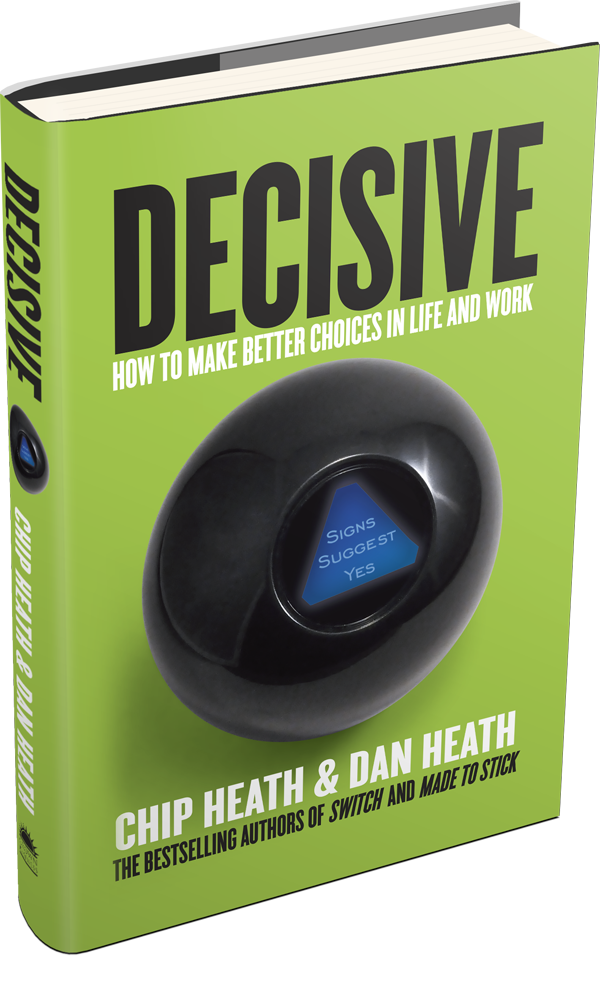
BR 144: Decisive by Chip Heath and Dan Heath

Category: 1 – Read ASAP! (All Categories are 1 – Read ASAP!, 2 – BUY it!, 3 – SHELF it, 4 – SOMEDAY it)

Comments: I think the Heath brothers are the best business book authors out there. Made to Stick was brilliant. They managed to surpass it with “Switch.” And, against the odds, they’ve delivered another great book.

As always, a perfect blend of stories, research “wrapped” in an easy-to-remember and apply framework. I’ve begun implementing the learnings from this book already and I’m sure it will go on to be a very important part of my decision making.

(Add on Mar 16 2016: Quick add more than a year after writing this post: This book did impact my decision making and I carry the WRAP framework card in my wallet. )

Top 3 learnings:

Instead of 3 learnings, I’ll share a somewhat long overall synthesis. Please ignore the formatting – this is just a copy paste. You’ll see a better formatted learnographic on http://www.learnographics.com soon. :)

The first step to decision making is understanding the difference between kind environments and wicked environments.

Kind environments – where feedback is clear, immediate, and unbiased by the act of prediction. e.g. the weather.

Wicked environments – where feedback is unclear, delayed and biased by the act of prediction. e.g. stock markets, new products introductions.

“Gut” works well in kind environments e.g. if you are well trained in chess/football, you know there are only so many different possibilities. So, your gut is an important data point.

In the stock markets, however, the gut might be a data point but doesn’t suffice.  Life is also a wicked environment. As a result, we tend to make decisions with narrow frames and overweight the short term.

We need a good decision making process to make good long term decisions. Hence, the WRAP framework –

W – Widen your options (avoid narrow frames and “whether or not” decisions)

R – Reality test your assumptions (fight confirmation bias)

A – Attain distance before deciding (resist short term influences, make decisions aligned to core priorities)

P – Prepare to be wrong (don’t get cocky about your decisions)

W – Widen your options (avoid narrow frames and “whether or not” decisions)

  1. Make sure you have at least 3 options before making a decision – and think AND not OR – can you follow multiple options at once?
    Whenever you hear a decision being prefaced by “whether or not,” it is time to reconsider.

  1. Find someone who has solved your problem.
    Sam Walton who made many Walmart decisions by copying competitors.

  2. Toggle between “Promotion” and “Prevention” mindsets.
    Circuit City’s actions in the aftermath of the 2001 stock market crash was a perfect example – they cut down underperforming stores (prevention) and also invested in new product lines (promotion)

R – Reality test your assumptions (fight confirmation bias)

  1. Tripadvisor it!  Zoom out (consider base rates) and zoom in (take a close up)
    Pick a job like you would a sushi bar on tripadvisor. Speak to lots of people and get an overall rating. Then, take a close up at negative feedback.
    Similarly, when engaging with experts, don’t ask them for predictions. Ask them historical trends and understand them to really understand your probabilities of success.

  2. Fight confirmation bias – spark constructive disagreement by considering the opposite point of view
    Alfred Sloan, legendary CEO of General Motors, refused to make decisions if there wasn’t at least one opposing point of view.

  3. Ooch before you leap
    An “ooch” is a small experiment to test a hypothesis. Approach a decision like a designer approaches a design – put together a prototype first and gather feedback.

A – Attain distance before deciding (resist short term influences, make decisions aligned to core priorities)

  1. Identify and refer to your 3 core priorities
    Take stock of what matters to you. You might decide against that expensive car if your long term priorities are to save and invest wisely.

  2. What would you advise your best friend to do? / What would a new person do?
    Intel took one of it’s biggest decisions after years of debate – getting out of memory and focusing entirely on processors – by asking the question “What would a new person do?”

  3. Try the 10/10/10 rule
    How would you feel 10 minutes from now? What about 10 months from now? And 10 years from now?

P – Prepare to be wrong (don’t get cocky about your decisions)

  1. Bookend the future – view it as a full spectrum of possibilities
    A top fund manager creates a whole range of potential future stock prices and a list of criteria that would make the upper end of the range more of a possibility. Predicting the future is impossible – viewing it as a spectrum of possibilities is realistic and guards against over confidence.

  2. Set a tripwire/trigger to review your decision
    What if Kodak, who religiously followed their 1980 report that said digital cameras would not get mainstream in the next decade, had a set a “tripwire” saying that they would review their decision not to enter digital cameras if adoption was greater than 10%? Would it have filed for bankruptcy in 2010?

  3. Create a realistic job preview
    Call centers did a much better job of retaining employees when they gave them a one day job preview taking them through the worst situations they might face. This triggered all sorts of coping mechanisms and also increased determination among the future employees.

If you were to make a quick spur-of-the-moment decision, I’d suggest a quick version of the WRAP process

W – Make sure you have at least 3 options or find someone who has solved your problem

R – Tripadvisor it!

A – Identify and refer to your 3 core priorities

P – View the future as a spectrum of possibilities and set a tripwire

The key principle – Follow and trust the process. You might fail on individual decisions. That’s okay.

Bookbytes here and learnographic here.

1. Read ASAP! · Book Review Actions · Book Reviews · Creativity · Leadership · Psychology · Self Improvement

BR 139: The Art of Possibility by Benjamin Zander and Rosamund Zander

Category: 1 – Read ASAP! (All Categories are 1 – Read ASAP!, 2 – BUY it!, 3 – SHELF it, 4 – SOMEDAY it)

Comments: The reason this book is in the top rung is not because it unearths some revolutionary or novel concept. It is because it advocates a way of thinking that has the power to revolutionize our life. Stephen Covey brought to light our ability to respond to situations (instead of just reacting to them) in his chapter “Be Proactive” but Ben and Roz take it to the next level by imploring us to make finding “possibility” a habit.

Top 3 learnings:

1. Remember rule no.6. Don’t take yourself so damn seriously. I need this on a plaque. :)

2. Seeing possibility is a way of life. It’s the learning approach to life – possibility has this magical ring to it. And rightly so.. viewing everything we do from the lens of possibility may be hard work but adds so much in terms of happiness, creativity, fun, and joy.

3. When you make a mistake, say “HOW fascinating.” Again, this isn’t just a cosmetic change. It involves a fundamental change in the way we view mistakes. Hard to do.. but I’m hopeful I will be able to implement it.

Book notes here

1. Read ASAP! · Book Review Actions · Book Reviews · Sales

BR 133: To Sell is Human by Daniel H Pink

Category: 1 – Read ASAP! (All Categories are 1 – Read ASAP!, 2 – BUY it!, 3 – SHELF it, 4 – SOMEDAY it)

Comments: Shaped how I think about selling. I’ve been a fan of Dan Pink’s approach of presenting well researched trends with a nice framework and “so what’s”   – ‘A Whole New Mind’ and ‘Drive’ did it well. “To Sell is Human” nails it.

Top 3 Learnings: Selling has moved from the old ABC (Always Be Closing) to the new ABC of Attunement, Buoyancy, and Clarity.

1. Attunement: This section is all about empathy, connection, and most importantly, asking great questions. The main trend here is that we have moved from information asymmetry between buyers and sellers to information symmetry. Buyers now have all the information that sellers have and don’t need sales people in the traditional sense. They need folks who will help them solve their problems.

2. Buoyancy: Recent research points to the important of having a healthy ratio of positive:negative thoughts but not approaching everything by just pumping yourself up. In fact, research shows that interrogative self talk (i.e. asking yourself – can I do it?) works much better.

It also involves learning optimism (Martin Seligman style) and making sure we aren’t knocked out by rejection.

3. Clarity: Clarity of purpose and making it personal are critical. Many many experiments show that an appeal to a deep, intrinsic purpose moves people.

1. Read ASAP! · Book Review Actions · Book Reviews · History · Money

BR 132: The Ascent of Money by Niall Ferguson

Category: 1 – Read ASAP! (All Categories are 1 – Read ASAP!, 2 – BUY it!, 3 – SHELF it, 4 – SOMEDAY it)

Comments: This is the sort of history book I enjoy. Hot on the heels of “A Splendid Exchange” and “Guns, Germs, and Steel,” this book is fantastic for those interested in understanding the story behind the financial infrastructure that exists today. Given the increasing spotlight on financial instruments (thanks largely to their failure), this is compulsory reading for anyone interested in understanding the real “infrastructure” of our development.

Top 3 learnings:

1. The world would NOT be a better place without our financial evolution. Credit and debit are critical to the growth of economies, businesses, and are the foundation to economic progress. Finance has underlined the big shifts in our societies. For example, the era of colonialism (or the first attempt at globalization) was only made possible by financial innovation – the dutch VOC was the first “public” company with a swath of public shareholders. The British emulated the Dutch and did it better.

2. War is the mother of all things. War was the real reason behind financial innovation. The concept of the bond market was created to fund wars between Italian states, the stock market was invented for better success in colonial wars.. and finance also played it’s part by being the real cause for wartime success and failure. The British triumph against Napoleon and the defeat of the south in  the American civil wars were determined more by financial causes than any other.

3. Credit is critical for growth. The biggest benefit of the modern day financial system is that a larger proportion of the population are able to escape the clutches of loan sharks who charge interest rates upto 11 million percent and thus keep the poor poor.

Book notes here

1. Read ASAP! · Book Review Actions · Book Reviews · Career · Leadership · Philosophy · Self Improvement

BR 131: How will you measure your life? by Clayton Christensen

Category: 1 – Read ASAP! (All Categories are 1 – Read ASAP!, 2 – BUY it!, 3 – SHELF it, 4 – SOMEDAY it)

Comments: I wish I had gotten to this book sooner. Clayton Christensen has such a thorough and clear thought process that reading this book is like embarking on an interesting intellectual journey with him.

This book is all about “how” to think rather than “what” to do. It has inspired some immediate changes in my life and I’m sure will continue to do so.

I loved it. I’m sure I’ll be sharing stories from the book for a long long time.

Top 3 learnings:

1. Be careful about viewing indiscretions in terms of marginal cost i.e. maybe I’ll do it just this time. You might think you are making allowance for an extenuating circumstance but life is just a series of extenuating circumstances. No athlete starts out with doping in mind.. it happens one bad decision after another. We can’t commit to 99% of an idea. It’s 100% or nothing.

2. Don’t look products as something people buy. Look at them as things people rent to get a job done. Ikea doesn’t win because it has the most amazing furniture. It wins because people hire Ikea for a quick, painless, cost effective way of re-decorating a home.

Similarly, great relationships involve asking yourself – why would my partner hire a husband/wife in this situation? This way, we focus on empathizing with what the other person wants rather than giving them what we think they should want.

3. Be careful about outsourcing your capabilities – Capability = Resources (what) + processes (how) + priorities (why). Dell began outsourcing small parts of manufacturing to Asus.. and 16 years later, Asus was manufacturing the whole computer. Asus soon started it’s own line of computers and Dell could do nothing since it had outsources it’s capabilities.

It’s important to think of this in terms of our kids. If our kids are constantly raised by someone else and learn processes and priorities from someone else, whose kids are they?

Add on Mar 16, 2016: This book changed my life. Up there with Stephen Covey’s 7 Habits.

1. Read ASAP! · Book Review Actions · Book Reviews · Psychology · Self Improvement

BR 125: Willpower by Roy Baumeister

Category: 1 – Read ASAP! (All Categories are 1 – Read ASAP!, 2 – BUY it!, 3 – SHELF it, 4 – SOMEDAY it)

Comments: Brilliant book by one of the pioneers of Willpower research.

Top 3 learnings:

1. Will power is like a muscle. There is only so much reserve we have until we recharge. That reserve is what we tap into for various activities in a day – primarily in the categories of resisting temptations and doing things that we don’t want to do that are generally good for us.

For example, we extract will power out of this reserve to resist a delicious chocolate snack as well as to keep patience while interacting with a frustrating co-worker.

2. Ego depletion is a serious issue. The depletion of this will power reserve results in ego depletion. Ego depletion is interesting – all of a sudden we lose self control and hit the “what the hell” effect. As a result, we suddenly irrationally indulge. So, if we hit ego depletion while on a diet, we suddenly go on a crazy binge.

Ego depletion explains why important people often make really stupid decisions in their personal life – sex scandals, etc. Decision making plays havoc with will power and ego depletion results in indulgence.

So, how do we prevent ego depletion? a) Food at regular intervals as glucose is critical to will power b) Sleep – the only long term recharge available!

(Ego depletion is what is referred to in the quote “things will look better in the morning”)

3. The best use of will power is to form habits.

Let’s take an example – I want to exercise every morning before I get to work. It’s not sustainable to keep using will power every day as I’ll start the day with very little in reserve. Instead, I ought to use the will power to create a cue, habit and reward to create a sustainable exercise habit. Once this is done, I won’t have to worry about exercise since it becomes an automatic process.

This explains what successful people do well. They use their will power reserves wisely to create great habits!

(See our learnographic for a summary)

1. Read ASAP! · Bio/Autobiographies · Book Review Actions · Book Reviews · Philosophy · Psychology

BR 119: Man’s Search for Meaning by Viktor.E.Frankl

Category: 1 – Read ASAP! (All Categories are 1 – Read ASAP!, 2 – BUY it!, 3 – SHELF it, 4 – SOMEDAY it)

Comments: Man’s search for meaning is as sincere and heartfelt a book you will find. It’s one of those books that is a must read simply because it teaches us what it means to be human.

The story details the experiences of Dr Frankl in Nazi concentration camps and his observations about life and the importance of meaning.

Top 3 Learnings:

1. We are often told that the essence of life is the pursuit of happiness. Frankl’s experiences taught him otherwise. In his experience, it’s meaning that makes life worth living..

2. There is an incredible paragraph on love by Viktor Frankl. It’s one of those that reminds us of the importance of love in this world, and the special place it holds in our life.

3. Success and happiness will ensue if we keep doing the right things. At the end of the day, we will be successful only because we forgot to think about it. Here’s the link to that incredible paragraph.

1. Read ASAP! · Book Review Actions · Career · Entrepreneurship · Self Improvement

BR 117: So Good They Can’t Ignore You by Cal Newport


Category: 1 – Read ASAP! (All Categories are 1 – Read ASAP!, 2 – BUY it!, 3 – SHELF it, 4 – SOMEDAY it)

Comments: Top draw. Probably the best career book out there. Busts some really common myths and is really SO good you shouldn’t ignore it.

Top 3 learnings:

1. Follow your passion is bad advice. Working right trumps finding the right work. It is  all about “the approach” to work.

2. Adopt the “craftsman mindset” i.e. the mindset of someone who is willing to put in the hours of deliberate practice to hone their craft. Adopting this mindset means you focus your energies on being the best you can be. This, in turn, gives you career capital.

3. Once you get damn good, the chances are that you will love what you do thanks to being the craftsman. You can now also trade career capital in for more control and autonomy in your life.

Once again, top draw career book.

1. Read ASAP! · Novel Concepts and Interesting Research · Psychology

BR 116: The Honest Truth About Dishonesty by Dan Ariely

Category: 1 – Read ASAP! (All Categories are 1 – Read ASAP!, 2 – BUY it!, 3 – SHELF it, 4 – SOMEDAY it)

Comments: Another Dan Ariely masterclass with very practical information about cheating. Very useful for us when we define “trust” systems as well as in our lifelong quest to manage ourselves.

Top 3 learnings:

1. Most people, when given a chance, cheat just a little bit. The reason for the “little bit” is that we work hard to stay consistent with our self image of being honest, straightforward people. But, at the same time, we find it hard to resist easy gains when we feel we cannot be found out.

2. Any reminders of ethics and responsibilities completely removes this cheating element e.g. students who were asked to recollect the ten commandments before heading into this experiment did not cheap. Similarly, signing honor codes etc at the start of the document prevent all cheating.

3. Every little act of cheating gives rise to more. In a fascinating set of experiments, it was found that people who fear fake brands or rip offs were more likely to cheat and view the world with a more suspicious lens that people who didn’t. This was a big insight for me.

Essentially, the cost of fakes and illegal downloads goes far beyond reducing profits of the companies involved.

1. Read ASAP! · Book Review Actions · Book Reviews · Novel Concepts and Interesting Research · Philosophy · Psychology

BR 100: The Happiness Hypothesis by Jonathan Haidt

Category: 1 – Read ASAP! (All Categories are 1 – Read ASAP!, 2 – BUY it!, 3 – SHELF it, 4 – SOMEDAY it)

Comments: Fitting that the 100th book review would be about one of the best books I have read.

Top 3 Learnings:

1. Emotions trump logic ANY day! The relationship between the two is akin to a rider atop an elephant. If the elephant (emotions) decides to go some place, the rider makes up reasons to go to that place.

2. We all have natural thresholds for happiness. Some have higher thresholds – that’s natural. What that means is that our happiness levels fluctuate between a range. And it gives us a simple goal –  stay on the top end of the range!

3. Everything in moderation..

4. Little things done daily have huge impact on our happiness. Keeping a journal, reflecting, counting our blessings etc

I really could go on. This is one of those books that you will never regret reading. A true masterpiece. Go get it.