2. BUY it! · Book Review Actions · Book Reviews · Novel Concepts and Interesting Research · Psychology · Relationships · Self Improvement

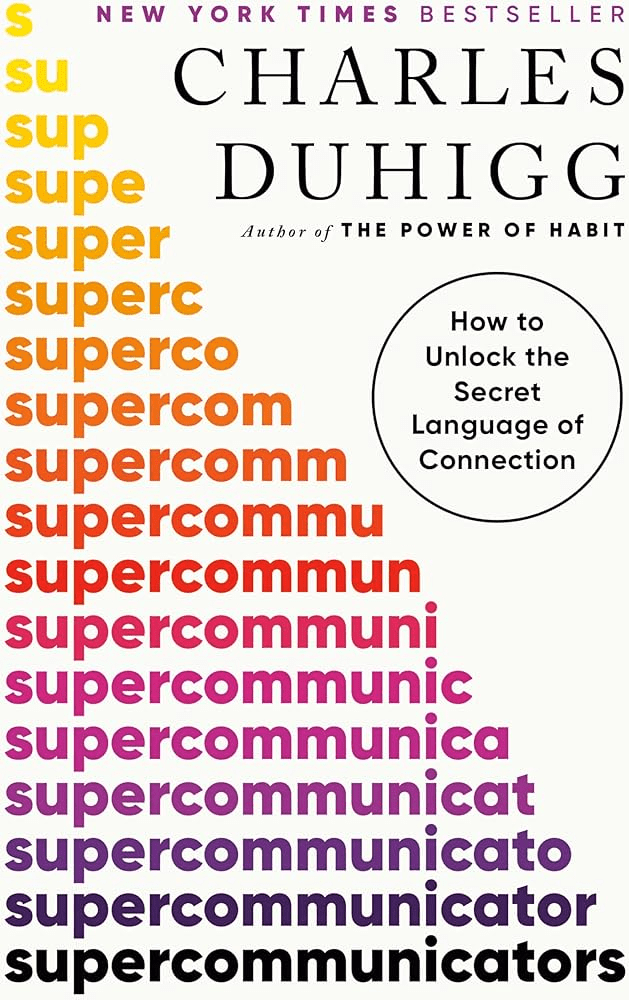
BR 315: Supercommunicators by Charles Duhigg

Category: 2 – BUY it! (All Categories are 1 – Read ASAP!, 2 – BUY it!, 3 – SHELF it, 4 – SOMEDAY it)

Comments: Solid book with a nice combination of stories and research about great communication.

Insights that resonated: 

(1) What kind of conversation are we in: Does the other person want to be helped, hugged, or heard?

(2) Effective communication often comes down to our ability to match the mood and energy of the person we’re communicating with. 

(3) The most powerful thing we can do to show that we are seeking to understand and not to be understood in a tense conversation is to: (a) take the time to wait for the person to finish, (b) then play back what we understood and, (c) check if what we understood was what they were trying to say.

(4) “While there are many factors that determine if a romantic relationship succeeds or flounders, one key factor is whether makes the people in it feel more in control of their happiness or less in control of their happiness.”

In detailed examinations of conversations among unhappy couples, researchers found that the partners tended to focus on trying to control the other person. For example, they might say “don’t go there” or “don’t use your voice against me” or “you always do this all that.”

Happy couples instead focused either on controlling themselves or the environment. For example, they’d talk slower and make sure that they kept that cool. The key with happy couples was focusing on things that they could control together and ensuring that they kept an argument as small as possible, instead of letting it expand into other areas and throwing “the kitchen sink” at each other.

(5) Social identities have a noticeable impact in our behavior. For example, without any intervention, studies with graduate level students found that women consistently performed consistently worse than men in math tests. That’s because, by default, they were aware of a stereotype that women are worse at math than men.

However, in tests where these women were reminded of other identities, e.g. that of a puzzle-solver or a successful sportsperson, the performance differences disappeared.

These identities matter a ton in communication because conflicts escalate when they move from being about the topic to being perceived as threatening the person’s identity.

That’s where motivational interviewing comes in. With tricky issues, motivational interviewing focuses on asking questions to help a person understand both sides of an issue and why they might be for against it.

The goal isn’t to persuade – it is to simply understand both sides of the issues and reinforce that there are other identities they could choose. He made the point with fascinating examples involving polarizing issues such as gun rights and vaccines.

(5) From 7 decades of data from the famous Grant study, the people who were most satisfied in the relationships at age 50 were the healthiest and happiest at age 80. One researcher put it bluntly – “The most defining factor for happiness and satisfaction of life is love, not romantic love, but the love and connection with our friends, family, coworkers and their community.”
2. BUY it! · Book Review Actions · Creativity

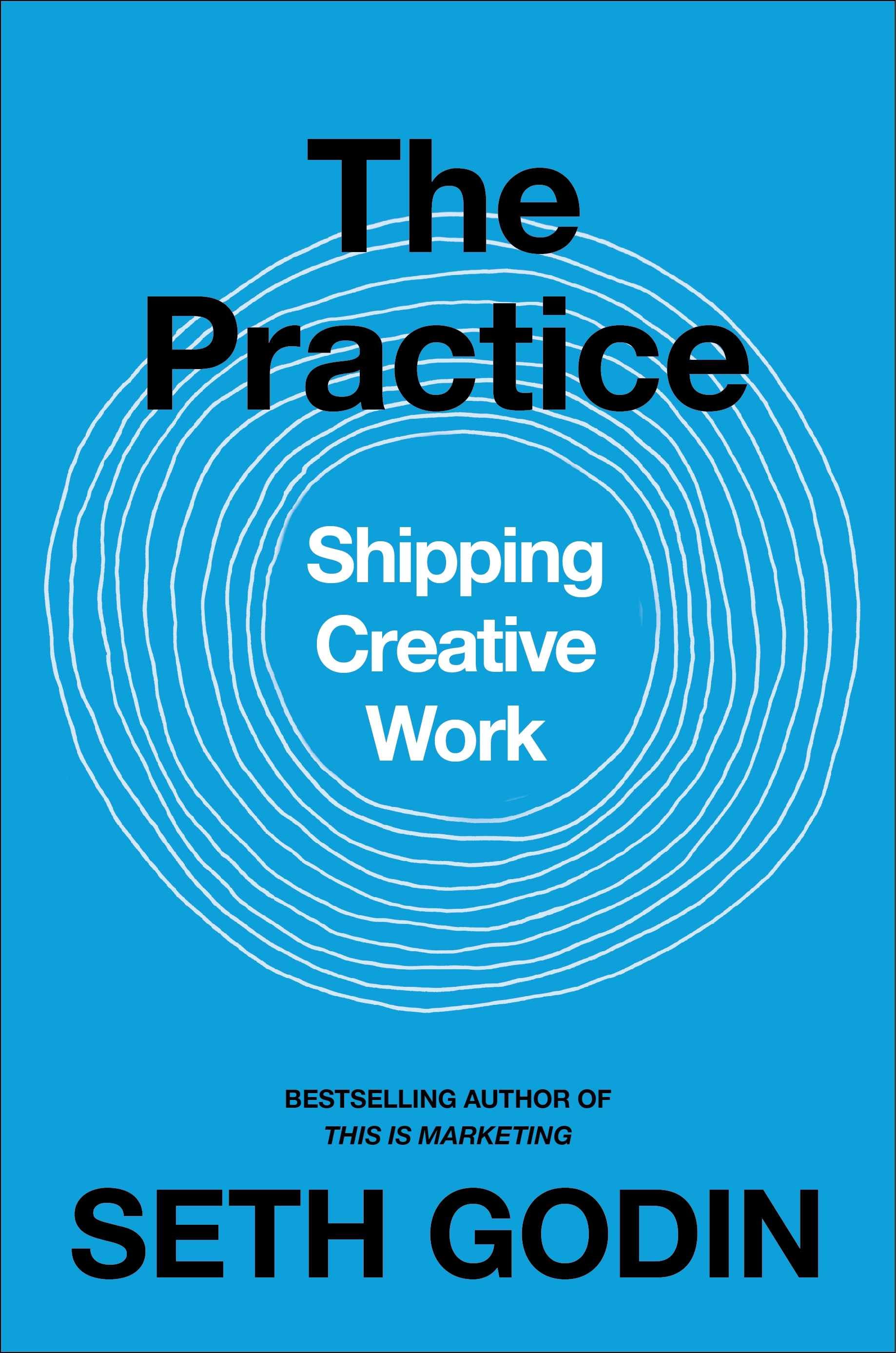
BR 294: The Practice by Seth Godin

Category: 2 – BUY it! (All Categories are 1 – Read ASAP!, 2 – BUY it!, 3 – SHELF it, 4 – SOMEDAY it)

Comments: Seth’s blog is my favorite blog – my first read every time it shows up on my feed. I love seeing Seth’s books on my shelf as I pick them up when I need inspiration. They always deliver. Seth’s voice and message is consistent and uplifting.

Insights that resonated: 

(1) Seth shares a great story about an author called Robert Caro in “The Practice.” Caro had quit his job as a reporter and begun writing his first major biography – “The Power Broker.”

He took a modest advance and moved his family to a tiny apartment. But, years later, the end didn’t seem in sight. In 1975, he wrote a poignant story for The New York Times describing his despair.

Then, he was given a key to a back room at the New York Public Library. Only eleven writers had keys, and each was given a desk to write.

One day, he looked up and found James Flexner – one of his idols – ask a question he’d come to dread – “How long have you been working on it?”

“Five years”

“Oh, that’s not so long. I’ve been working on my Washington for nine years.”

The next day, another of his idols said quietly – “Eleanor and Franklin took me seven.”

He could have jumped up and kissed them. In a couple of sentences, both men – his idols – had wiped away five years of doubt.

The lesson “Find your cohort. The generous ones.” resonated deeply.

(2) “Asking why teaches you to see how things got to be the way they are. Asking why also puts us on the hook – it means that we’re also open to being asked why, and it means that at some level, we’re now responsible for doing something about the status quo.”

(3)

“If you want to get in shape, it’s not difficult. Spend an hour a day running or at the gym. Do that for six months or a year. Done.

That’s not the difficult part.

The difficult part is becoming the kind of person who goes to the gym every day.”

2. BUY it! · Bio/Autobiographies · Book Review Actions · Book Reviews · Business · Career · Entrepreneurship · Technology

BR 292: Build by Tony Faddell

Category: 2 – BUY it! (All Categories are 1 – Read ASAP!, 2 – BUY it!, 3 – SHELF it, 4 – SOMEDAY it)

Comments: I enjoyed Tony Fadell’s book. It felt honest, direct, and helpful.

Insights that resonated: 

(1) I appreciated the many Apple/Steve Jobs stories. Some of it confirmed Steve’s intensity (e.g., Jobs on vacation was worse than Jobs at work) and some of it also showed just how much Steve cared about the details. For example, there was a lot of debate between Apple’s product and marketing teams about an “all glass” iPhone. The marketing team wanted something similar to the Blackberry. Steve simply stepped in, made the call, and asked the team to move on.

(2) I appreciated how long Tony spent thinking about thermostats. There’s a whole saga about thermostats at his home in Tahoe. My mental model for starting a company is that you should only start a company when you can’t not do it. It certainly was the case with Nest.

(3) Tony’s story about Nest at Google was a true and sobering look at big company acquisitions. Few work as intended.

(4) Tony keeps driving home the importance of having high standards as a leader. Everything flows from there. That resonated.

2. BUY it! · Business · Psychology · Skills

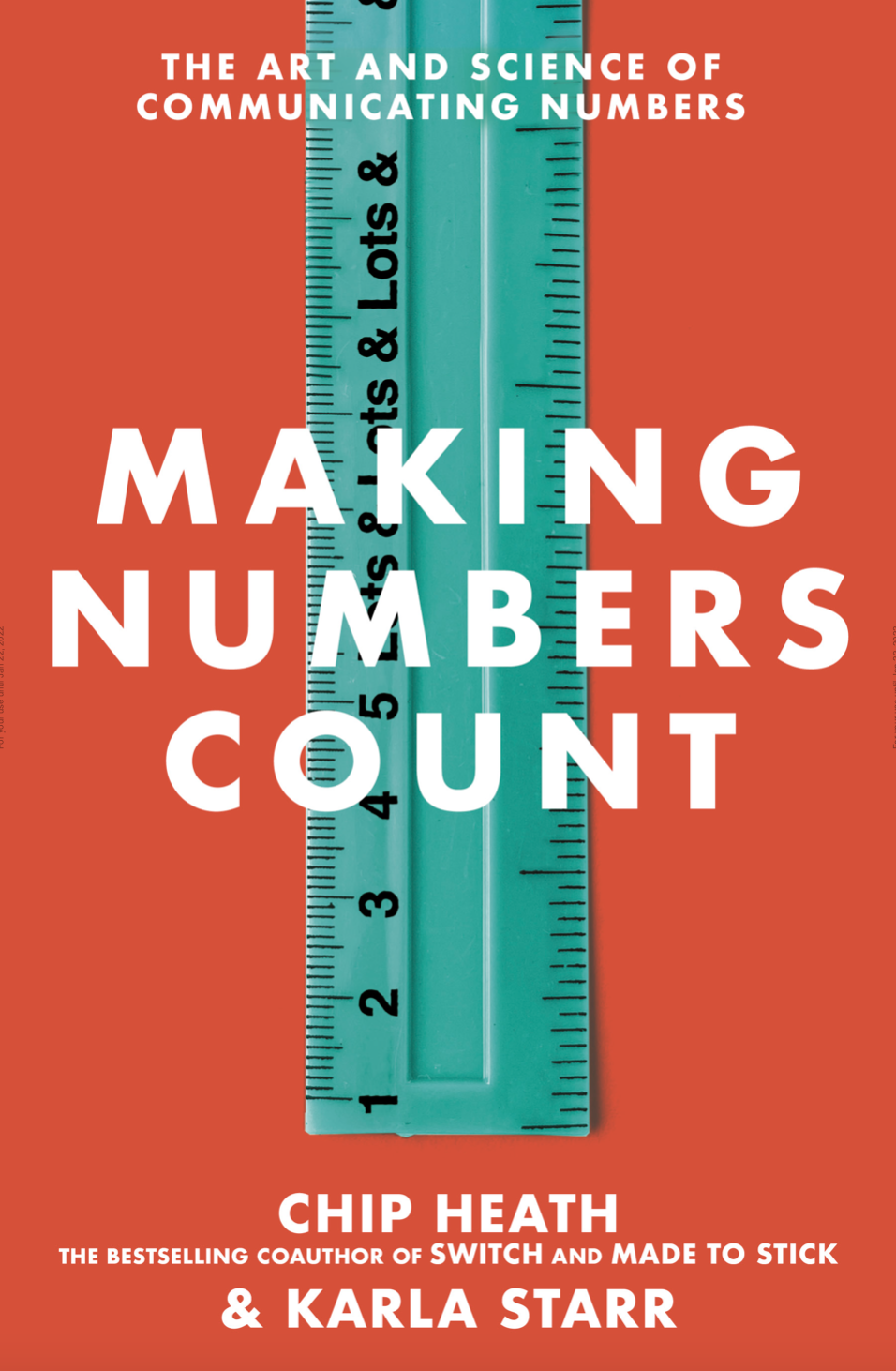
BR 287: Making Numbers Count by Chip Heath and Karla Starr

Category: 2 – BUY it! (All Categories are 1 – Read ASAP!, 2 – BUY it!, 3 – SHELF it, 4 – SOMEDAY it)

Comments: Another Heath Brothers classic – interesting research put masterfully together to make a simple point -> take the time to think about how we use numbers to make a point. There’s a lot of upside to getting it right.

Insights that resonated: 

(1) A million seconds is 12 days from now. A billion seconds?

32 years.

That difference surprised me as it wasn’t what I expected. A billion is significantly bigger than I had imagined.

We don’t have an intuitive understanding of big numbers. The implication is that we need to make the effort to always put numbers in context for the people we’re presenting to.

(2) Some “translations” that resonated:

The fastest human, Usain Bolt, would be beaten in a 100m dash by a Rhino by 2s and would be close to a Chimpanzee. he wouldn’t be close to a Cheetah or an Ostrich.

If cows were a country, they’d be #4 in Carbon emissions. They emit more than Saudi Arabia or Australia.

Apple market cap wealth is greater than 150 out of 171 countries. (or at least was – until recently :-))

If California were a country, it’s GDP would be more than all but 5 countries in the world.

Six sigma is 3.4 defects per millions. That means baking 2 decent chocolate chip cookies every day and going 37 years before baking one without a defect.

If everyone ate as much meat as a person in America, we would need to use every bit of land on the planet and add an extra Africa and Australia to meet the demand 

Imagine your (US) tax payment is visualized as employment over the course of a year. It would mean working 2 weeks for social security, 2 weeks for Medicare and Medicaid, 5 days on national debt, 1.5 weeks for Defence, then most of the rest of the year would be government payroll, 6 hours for “SNAP” (Nutrition assistance), 12 minutes to National Parks, and 2 mins to NASA.

Translations make abstract numbers accessible.

(3) Florence Nightingale was a data wizard (more in the book ;-)).

2. BUY it! · Psychology · Relationships

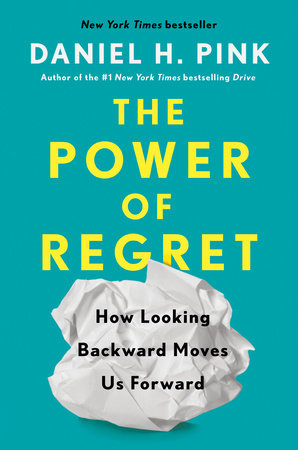
BR 283: The Power of Regret by Dan Pink

Category: 2 – BUY it! (All Categories are 1 – Read ASAP!, 2 – BUY it!, 3 – SHELF it, 4 – SOMEDAY it)

Comments: This is a classic Dan Pink book – well researched, extremely well structured, and chock full of thought provoking notes.

Insights that resonated: Dan recently shared a summary of the book in a few paragraphs in a short “graduation speech.” My cliff notes –

(1) Foundation regrets“The first of the big four regrets is what I call Foundation regrets. Foundation regrets emerge from small choices we make earlier in life that accumulate to negative consequences later in life.

We spend too much and save too little. We don’t eat right, sleep enough, or exercise
regularly. We apply only grudging effort on the job – or, yes, in the classroom”

“Foundation regrets sound like this: If only I’d done the work.”

(2) Boldness regrets“All regrets begin when we’re at a juncture. And with this category, the juncture presents a choice: Play it safe – or take the chance? And when we don’t take the chance – not all the time, but most of the time – we regret it.”

Boldness regrets sound like this: If only I’d taken the chance.

(3) Moral regrets“Once again, we’re at a juncture. We can take the high road
or we can take the low road. And when we choose what our conscience says is the wrong path, most of us – most of the time – regret it.

We hurt others. We break our word. We degrade what ought to be revered. And while at first the decision can feel fine – even exhilarating – before long it eats at us.”

“Moral regrets sound like this: If only I’d done the right thing.”

(4) Connection regrets“These are regrets about all the relationships in our lives. Partners. Parents. Children. Siblings. Cousins. Friends. Colleagues. Classmates.
A 45-year-old woman, from the District of Columbia, offered this: “My brother died
suddenly at forty-one. I regret not saying, ‘I love you,’ more.””

Connection regrets sound like this: If only I’d reached out.

(5) That brings us to the reverse image of a life well lived.

A decent foundation – enough stability so that life is not precarious. Boldness – a chance to learn and grow and do something meaningful during the vanishingly short time we’re alive. Morality – being good and decent and just. Connection – having people we love and who love us.

Or put differently.

Do the work.

Take the chance.

Do the right thing.

Reach out.

And ignore the rest.

2. BUY it! · Book Review Actions · Book Reviews · Business · Technology

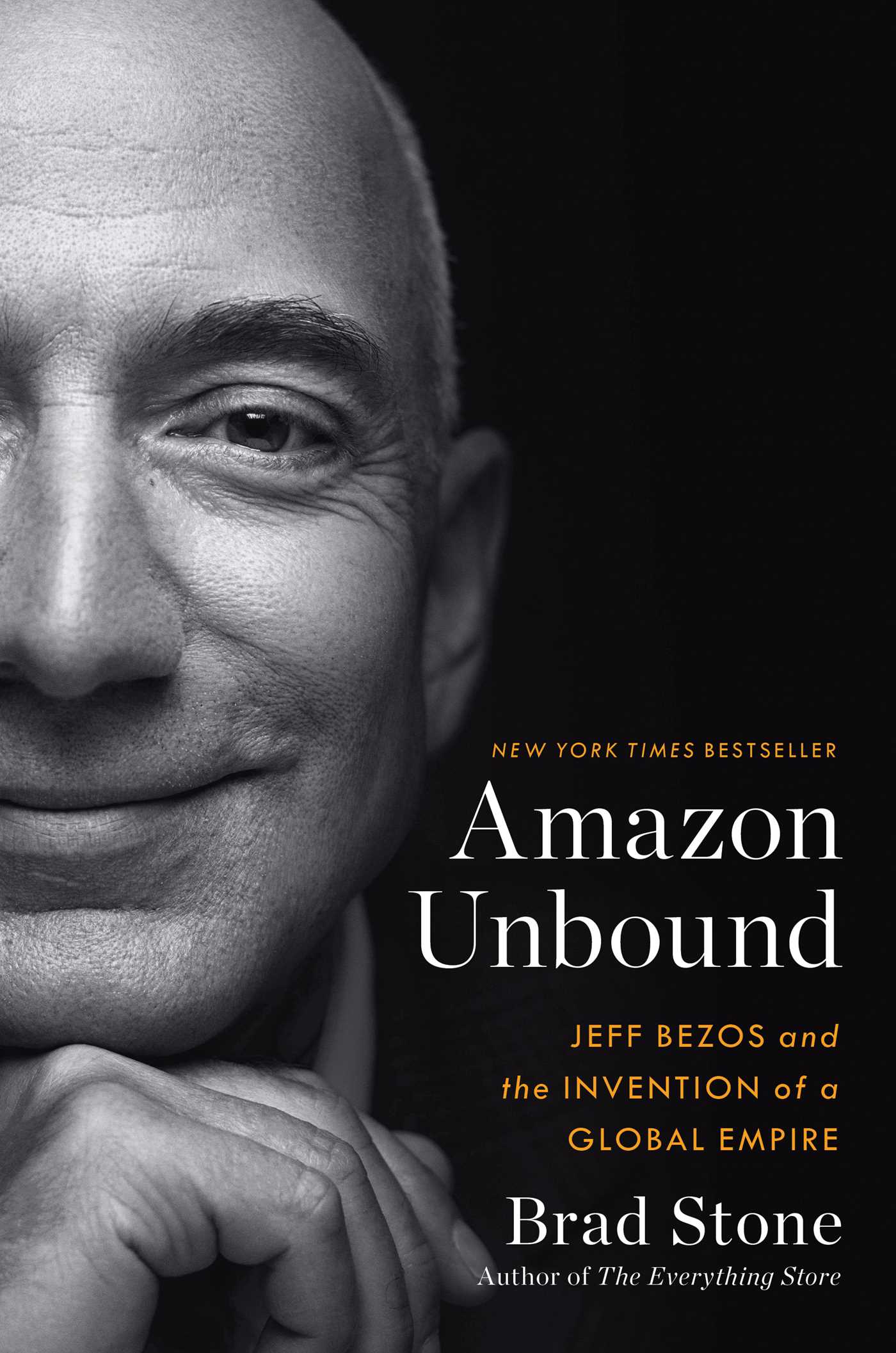
BR 281: Amazon Unbound by Brad Stone

Category: 2 – BUY it! (All Categories are 1 – Read ASAP!, 2 – BUY it!, 3 – SHELF it, 4 – SOMEDAY it)

Comments: Amazon Unbound is the follow up to Brad Stone’s excellent first book about Amazon – “The Everything Store.” It chronicles the growth of Amazon from incredible retailer to an all conquering conglomerate. A fascinating read for anyone interested in technology.

Insights that resonated: 
(1) “It has always seemed strange to me…The things we admire in men, kindness and generosity, openness, honesty, understanding and feeling, are the concomitants of failure in our system. And those traits we detest, sharpness, greed, acquisitiveness, meanness, egotism and self-interest, are the traits of success. And while men admire the quality of the first they love the produce of the second.” | John Steinbeck

An amazing starting quote.

(2) I was repeatedly blown away by Jeff Bezos’ propensity to invest in new and interesting bets. There are a number of occasions where his best and brightest share conversations with him that led to their deployment into a completely new and unproven bet. These bets went onto become billion dollar companies. But, the intentionality with which Bezos went after these – both in deploying high potential talent and staying close to it in the early days – was telling.

(3) The book drove home how much Amazon culture just resembles Jeff Bezos. The drive and intensity of the company mirrors Jeff’s drive and intensity.

(4) Brad also spent time on how wealth changed Jeff – leading eventually to the failure of his marriage. Extreme wealth and celebrity are very hard to handle.

2. BUY it! · Book Review Actions · Book Reviews · Philosophy

BR 272: A Guide to the Good Life by William B Irvine

Category: 2 – BUY it! (All Categories are 1 – Read ASAP!, 2 – BUY it!, 3 – SHELF it, 4 – SOMEDAY it)

Comments: If you have any interest in philosophy or stoicism, this book would be in the “Read ASAP” list. It is an awesome Stoicism 101 – the sort of book that could be a course in Stoic philosophy.

Insights that resonated: While there were individual lessons like negative visualization or many notes on focusing on the process that reminded me of the Bhagavad Gita, the best thing the book did was inspire more reading. Following this, I began compiling notes/principles that resonated and began reading the trifecta of Seneca, Marcus Aurelius, and Epictetus.

Thank you, William Irvine, for a beautiful synthesis.

2. BUY it! · Book Review Actions · Book Reviews · Creativity · Skills

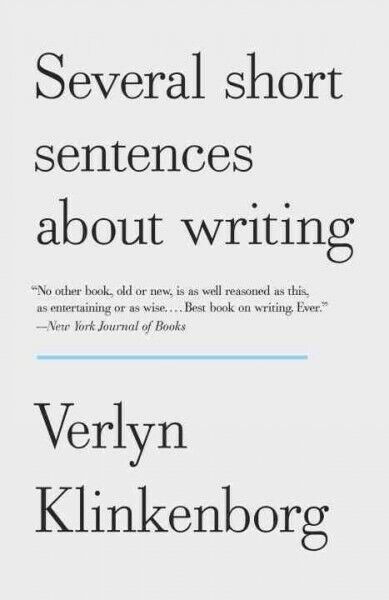
BR 270: Several short sentences about writing by Verlyn Klinkenborg

Category: 2 – BUY it! (All Categories are 1 – Read ASAP!, 2 – BUY it!, 3 – SHELF it, 4 – SOMEDAY it)

Comments: This is a fantastic book on writing. A true masterpiece. As an added bonus, it has plenty of wisdom about skills, practice, and life.

Insights that resonated: I’ve shared a few passages that resonated deeply here. My favorite is the one below.

Why are we talking about sentences?
Why no talk about the work as a whole, about shape, form, genre, the book, the feature story, the profile, even the paragraph?

The answer is simple.
Your job as a writer is making sentences.
Most of your time will be spent making sentences in your head.
In your head.
Did no one ever tell you this?
That is the writer’s life.
Never imagine you’ve left the level of the sentence behind.

2. BUY it! · Book Review Actions · Book Reviews · History · Money

BR 269: Debt by David Graeber

Category: 2 – BUY it! (All Categories are 1 – Read ASAP!, 2 – BUY it!, 3 – SHELF it, 4 – SOMEDAY it)

Comments: There are a few special books that change our perspective by telling us the story of our past. “A Splendid Exchange” and “Guns, Germs, and Steel” do so from the lens of trade and conquest. “The Accidental Superpower” views the past from the lens of changing superpowers. “Sapiens” does so from the lens of human evolution. And, “Debt” does so from the lens of… well.. debt.

With every one of these books, we may not agree with everything the author says. That’s expected when you’re attempting to synthesize thousands of years of human history. But, these books are worth reading because understanding what came before us helps put into context what we’re experiencing today.

And, every once in a while, they also helps provide clues about what might lie ahead. History doesn’t repeat but it often rhymes.

Insights that resonated: 

1. The notion that money began because of barter is a myth. Barter is simply a logical sounding story made up by economists. To understand money, we need to look at credit/debt.

2. It is fascinating how there were similar arcs of progress in different places around the world. As different as these people and places were, there were still strong similarities in the way civilization progressed.

3. While luck plays a massive role in our lives (determines ~70% of our outcomes by my estimation) today, that role was even arguably larger (>90%) in the past. If you were born in the wrong family, you were stuck, screwed, or likely to die a brutal death.

2. BUY it! · Book Review Actions · Book Reviews · Money · Psychology

BR 263: Psychology of Money by Morgan Housel

Category: 2 – BUY it! (All Categories are 1 – Read ASAP!, 2 – BUY it!, 3 – SHELF it, 4 – SOMEDAY it)

Comments: This is an interesting book because it isn’t about how to invest or how to think about money. Instead, I describe it as a book that is about how to think about thinking about money. It is a collection of stories and anecdotes that you’ve likely heard of before and that provide food for thought. And, it can either be a light heavy read depending on how you’re feeling.

I walked away with a list of questions that I intend to work through in the coming days. It made me think. And, for that I’m grateful.

Insights that resonated:

1. Our savings = Our earnings – Cost of essentials – Cost of our ego (all expenses related to looking good)

2. Manage your money in a way that helps you sleep well at night. 

3. Luck and risk in complex systems explain outcomes better than deliberate action. Respect them. Then do what you control. 

4. The key with compounding is to not interrupt it. 99% of Warren Buffett’s net worth came after his 50th birthday, and 97% came after he turned 65.

5. Luck and risk in complex systems explain outcomes better than deliberate action. Respect them. Then do what you control.