1. Read ASAP! · Book Review Actions · Book Reviews · History · Novel Concepts and Interesting Research · Technology

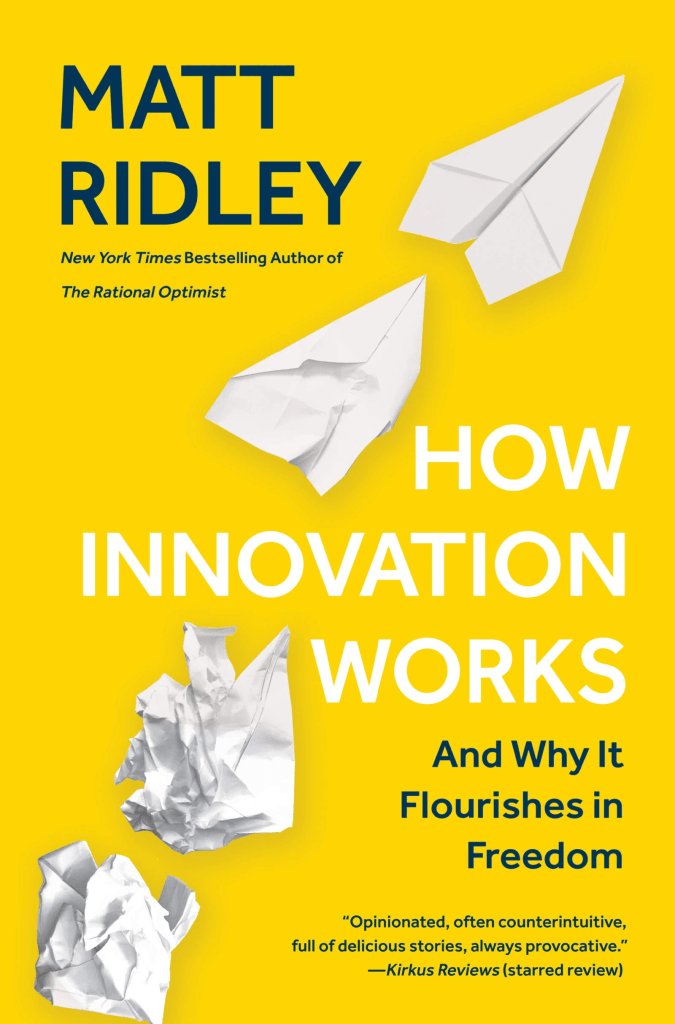
BR 314: How Innovation Works by Matt Ridley

Category: 1 – Read ASAP! (All Categories are 1 – Read ASAP!, 2 – BUY it!, 3 – SHELF it, 4 – SOMEDAY it)

Comments: Matt Ridley’s “How Innovation Works” was rich with insight. A great book.

Insights that resonated:

(1) “The main ingredient in the secret sauce that leads to innovation is freedom. Freedom to exchange, experiment, imagine, invest and fail; freedom from the expropriation or restriction by chiefs, priests and thieves. Freedom on the part of consumers to reward the innovations they like and reject what they don’t.”

This note from the final chapter is a point Ridley makes again and again. History has repeatedly shown free societies to be more innovative.

(2) Innovation works better bottoms up vs. tops down and when there is less burden of regulation. Example after example demonstrates how empires resist innovation (and even outright ban it). And, for a simple example of how burden of regulation kills innovation, we can look at how Europe’s regulatory changes over the past decade have only resulted in incumbents getting more entrenched and in the citizens of Europe getting access to sub-par technology.

(3) Regulation hobbles innovations because it increases the cost of learning. When learning costs go up, it is hard for us to iterate. Nuclear energy is a stand out example of this.

Also, regulation changes incentives. Instead of people spending energy to invent new things, they spend their energy in making friends with the government to bend the rules.

Iteration is key – it is what has saved millions of lives from diseases like whooping cough and malaria.

(4) “Innovation happens not within but between brains.” The “great man” theory is one we’ve created out of convenience and due (more recently) to intellectual property law.

Innovation has consistently arrived because of humans who chose to build on the work of their rivals and predecessors and combine existing ideas in interesting ways.

Crucial innovations are often thought to have been accelerated by war. However, most innovation has happened incrementally and has been driven forward by many people.

Innovations come when their time comes – regardless of the people involved.

(5) Growth never needs to stop. The nature of growth is such that we first figure out how to produce more. Then we learn how to produce more with less. Until our efficiencies far outweigh our appetite.

Light is a great example. Once the cost of light goes down, more people leave their lights on. However, the efficiency of LEDs mean we’re more efficient than ever before.

(6) Every innovation has been resisted. Politicians in India and Pakistan resisted the Green revolution. Europe was prejudiced against the humble potato.

These are examples of innovations that made their way through (most good ones make it over time). However, there are examples of innovations that haven’t – in multiple places because of successful smear campaigns.

Then again, there are others that were delayed. For example, Dyson fought a decade long battle to get its innovative bag-less vacuum cleaner approved in the EU (crazy, I know).

In effect, there is no such thing as a no brainer. As long as incentives to resist something exists, resistance will exist.

(7) “The main theme of human history is that we become steadily more specialized in what we produce, and steadily more diversified in what we consume: we move away from precarious self-sufficiency to safer mutual interdependence.”

Beautifully put.

1. Read ASAP! · Book Review Actions · Book Reviews · History · Novel Concepts and Interesting Research · Psychology

BR 306: Same as ever by Morgan Housel

Category: 1 – Read ASAP! (All Categories are 1 – Read ASAP!, 2 – BUY it!, 3 – SHELF it, 4 – SOMEDAY it)

Comments: I have been a Morgan Housel fan for over a decade. He’s gone onto earn deserved praise for his exceptional writing style that mixes powerful anecdotes with timeless wisdom about investing and life.

Same as ever is classic Morgan Housel.

Insights that resonated: 

(1) The world isn’t crazier than it was before. With 8 billion people, crazy things every day are inevitable. 

(2) Calm plants the seeds of crazy. If stocks keep going up, the market is going to get too confident. That, then, will lead to a crash.

The world is calmer and safer than ever before – primarily because of the progress we’ve made against deadly diseases thanks to vaccines. But that made us over-confident and thoroughly unprepared for a pandemic. And so on.

Every time this (recession, pandemic, etc.) happens, we will feel the pain of the wound. The wounds will heal but the scars will last.

(3) Slow progress among a barrage of bad news is normal. Bad news is about what happened, good news is invisible because it is about things that didn’t happen. Improvements in heart disease at 1% per year for 70 years saved 25 million Americans. It’d never make the headlines any given year. But, over 7 decades, it is massive.

(4) Plan like a pessimist, dream like an optimist. The key is surviving the short term to make it to the long term. 

(5) It’s supposed to be hard

In 1990, David Letterman asked his friend Jerry Seinfeld how his new sitcom was going. Jerry said there was one frustrating problem: NBC supplied the show with teams of comedy writers, and he didn’t think they were getting much good material from them.

“Wouldn’t it be weirder if they were good?” David asked.

“What do you mean?” Jerry asked.

“Wouldn’t it be strange if they could all just produce reams of hilarious material day after day?”

Recalling the conversation a few years ago, Seinfeld laughed and told Letterman: “It’s supposed to be hard.”

(6) The grass is greener on the other side because it is fertilized by bullshit. You only get the smell when you come close enough. This idea might have been my favorite.

(7) Incentives are the most powerful force in the world.

1. Read ASAP! · Book Review Actions · Book Reviews · History · Novel Concepts and Interesting Research · Psychology

BR 278: Caste by Isabel Wilkerson

See the source image

Category: 1 – Read ASAP! (All Categories are 1 – Read ASAP!, 2 – BUY it!, 3 – SHELF it, 4 – SOMEDAY it)

Comments: A perspective changer.

Insights that resonated: 

(1) Isabel Wilkerson’s book “Caste” is a recent read that I’ve thought about a lot. It is fascinating to dig into the history of a place. I’ve had some insight into the institution of slavery in the United States. But, there’s nothing like the kind of insight a seasoned reporter brings.

It was particularly powerful for me as she draws parallels to the treatment of Jews in Nazi Germany and the treatment of Dalits in India. She makes the case that calling this “racism” is a simplification. Caste systems go deeper than that.

Stories about caste in India always sadden me. That’s not just because of the heartbreaking stories. They remind me of our collective stupidity and our unwillingness to learn from experience.

Most Indians – regardless of caste – were treated horribly by the British during the years of the British occupation. And, yet, despite all the shared humanity that helped us get through that experience, we didn’t take those lessons forward.

(2) While Isabel Wilkerson focuses on these 3 caste systems, the truth is that caste exists everywhere. Just like other popular western exports, a caste-like hierarchy based on skin color has become the most popular kind around the world. But, there are other systems too. When I lived in Saudi Arabia for 10 months, the dominant caste was Muslim for example. And, if you’ve traveled around the world without a western passport, the global immigration system will never fail to remind you about the importance of the color of your passport, your accent, and the color of your skin.

(3) At its heart, caste systems are about pecking order. We attempt to establish pecking orders wherever we go. Then, we go to crazy extents to maintain them.

This isn’t just true about nations. It is true about any human group. It is likely such pecking orders exist where we work – some function is the equivalent of the “dominant caste” and does all it can to preserve its status.

(4) It is hard to empathize with groups below the pecking order if you haven’t been there. That’s part of the human condition too. Reading stories in Isabel Wilkerson’s book is one thing. Experiencing it every day is another.

We live in the San Francisco Bay Area. This place likely has more immigrants per square foot than most places on the planet. And, yet, even in a place where we are not the lone outsiders, we experience situations that remind us of our status in the hierarchy.

This week, it was getting honked and told to “get out of the way” in a parking lot as we were unloading our bikes and kids. Last week, it was being told what to do in a car wash. We have a long catalog of these experiences. It is nearly always an older white/caucasian man who assumes he has the authority to tell us what we should do and how we should behave.

If this is our experience in the Bay Area, I can only begin to imagine the daily slights many others who are lower in the hierarchy experience. It is enough to drive you crazy.

And, yes, the frequency and intensity of these daily slights have likely gone down – on average – in the past decades. But, they’re still around.

(5) It takes a lot to see through false narratives of those who seek to use it for their gain. As Seth beautifully described, identity is often used against us.

We can hope for mature responses from time to time (this one warmed my heart).

But, I don’t see any way out of pecking orders and caste system. I think it is a side effect of our fallibility.

(6) While I don’t believe we’ll ever live in a world without arbitrary hierarchies, I do hope for progress toward that ideal. In a few years, the US will have as much of its history without slavery being legal as it spent with that institution.

I hope we’ll cross many more such milestones and move closer to a world where we spend more time thinking about what we have in common vs. what is different. Over time, maybe we’ll extend that to the plants and animals we’re blessed to share this space with. Before it is too late – at any rate.

The only way that will happen though is if we construct the kind of society that doesn’t gloss over our past. Our history is full of bloody wars and cruelty toward each other for arbitrary reasons. We have much to learn from all that bloodshed and suffering.

The more time we spend understanding our past, the more we will be able to understand the imperfections in our culture/community/country in the present.

No culture or country is perfect.

The problem is when we think we are.

3. SHELF it · Book Review Actions · Book Reviews · Creativity · History

BR 277: Geography of Genius by Eric Weiner

See the source image

Category: 3 – SHELF it (All Categories are 1 – Read ASAP!, 2 – BUY it!, 3 – SHELF it, 4 – SOMEDAY it)

Comments: This book was a classic Eric Weiner book – lots of fascinating stories artfully weaved together with humor. A fun read and one for the bookshelf for when you’re in the mood for it.

Insights that resonated: 

(1) “What is honored in a country is cultivated there.” | Plato

(2) “Walking quiets the mind without silencing it completely.” | Eric Weiner, Geography of Genius

2. BUY it! · Book Review Actions · Book Reviews · History · Money

BR 269: Debt by David Graeber

Category: 2 – BUY it! (All Categories are 1 – Read ASAP!, 2 – BUY it!, 3 – SHELF it, 4 – SOMEDAY it)

Comments: There are a few special books that change our perspective by telling us the story of our past. “A Splendid Exchange” and “Guns, Germs, and Steel” do so from the lens of trade and conquest. “The Accidental Superpower” views the past from the lens of changing superpowers. “Sapiens” does so from the lens of human evolution. And, “Debt” does so from the lens of… well.. debt.

With every one of these books, we may not agree with everything the author says. That’s expected when you’re attempting to synthesize thousands of years of human history. But, these books are worth reading because understanding what came before us helps put into context what we’re experiencing today.

And, every once in a while, they also helps provide clues about what might lie ahead. History doesn’t repeat but it often rhymes.

Insights that resonated: 

1. The notion that money began because of barter is a myth. Barter is simply a logical sounding story made up by economists. To understand money, we need to look at credit/debt.

2. It is fascinating how there were similar arcs of progress in different places around the world. As different as these people and places were, there were still strong similarities in the way civilization progressed.

3. While luck plays a massive role in our lives (determines ~70% of our outcomes by my estimation) today, that role was even arguably larger (>90%) in the past. If you were born in the wrong family, you were stuck, screwed, or likely to die a brutal death.

1. Read ASAP! · History · Novel Concepts and Interesting Research · Psychology

BR 230: Skin in the Game by Nassim Taleb

Category: 1 – Read ASAP! (All Categories are 1 – Read ASAP!, 2 – BUY it!, 3 – SHELF it, 4 – SOMEDAY it)

Comments: Albert Wenger has a great post explaining why you should read “Skin in the Game” that sums up my thoughts. Nassim Taleb is a brilliant jerk and it comes through in the book. There are moments of brilliance that make it well worth the experience and then there are moments when you are left shaking your head at his desire to pick fights and insult people for the sake of doing so. Albert also makes a great point at the end about reading books from folks we may not always agree with – “This is a good moment to point out that we should all seek out writers with whom we disagree at least some of the time. If we only read books by authors where we agree with every one of their tweets, why bother? What are we expecting to learn? Too many times we are letting our emotional reaction to something an author has said or done stand in the way of engaging with their arguments. Taleb certainly provokes a strong reaction at times, but by all means read “Skin in the Game” nonetheless.”

Top 3 Lessons:

  1. When someone says it is good for you when it is also good for them and when they don’t face downside, it isn’t good for you.
  2. Better fences make better neighbors. It is easier for people to like each other as neighbors than roommates. Interventionists keep trying to get people to not act sectarian when being sectarian is in our nature. Better to use that to keep groups and design systems that encourage us to work with each other. (Powerful implications in management and life)
  3. Loss aversion doesn’t exist (big statement!). The flaw in psychology papers is to believe that the subject doesn’t take any other tail risks anywhere outside the experiment and will never take tail risks again. The idea of “loss aversion” have not been thought through properly –it is not measurable the way it has been measured (if at all mesasurable). Say you ask a subject how much he would pay to insure a 1% probability of losing $100. You are trying to figure out how much he is “overpaying” for “risk aversion” or something even more stupid, “loss aversion”. But you cannot possibly ignore all the other present and future financial risks he will be taking. You need to figure out other risks in the real world: if he has a car outside that can be scratched, if he has a financial portfolio that can lose money, if he has a bakery that may risk a fine, if he has a child in college who may cost unexpectedly more, if he can be laid off. All these risks add up and the attitude of the subject reflects them all. Ruin is indivisible and invariant to the source of randomness that may cause it.
1. Read ASAP! · Book Review Actions · Book Reviews · History · Politics

BR 215: The Bad Samaritans by Ha-Joon Chang

Category: 1 – Read ASAP! (All Categories are 1 – Read ASAP!, 2 – BUY it!, 3 – SHELF it, 4 – SOMEDAY it)

Comments: A perspective changer. I was aware of the IMF, The World Bank and the World Trade Organization thanks to social science classes in middle school. But this was a compelling take on how their help can cause hurt.

Top 3 Learnings:

1. Every developed country rose to power thanks to protecting infant industries via imposing tariffs or protecting patents. But, they’ve sold the idea of free markets to the world so it is impossible for countries developing right now to do it. The US was the most protectionist country in the world until the Second World War and grew the fastest. Britain and the US had tariffs as high as 50%.

2. This is particularly because the IMF, World Bank and WTO (i.e. the bad samaritans) are run by developed countries and only offer aid in exchange for policies that suit developed countries. It is very hard for poor countries to out-negotiate the rich countries in Geneva given paucity of resources.

3. In the first few years after 1900, multiple books described the Japanese as lazy, care free and emotional people. Similarly in the 1800s, the British and French described Germans the same way.
Economic development often creates the culture it needs. Hard work, time keeping, frugality often follow economic development.

1. Read ASAP! · Book Review Actions · Book Reviews · History · Novel Concepts and Interesting Research

BR 212: Sapiens by Yuval Noah Harari

Category: 1 – Read ASAP! (All Categories are 1 – Read ASAP!, 2 – BUY it!, 3 – SHELF it, 4 – SOMEDAY it)

Comments: A game changing book. It is long, dense and takes a while to get through. But, my oh my, it is worth it. I love books that look at all of human history through various lenses. This one tells the story of Homo Sapiens from Yuval Harari’s perspective and beautifully weaves in all that is ugly, beautiful and miraculous all at once. Fascinating.

Top 3 Learnings:

1. Fiction. Thanks to language, we were able to speak about abstract concepts and/or fiction. It is one of the unique aspects of our language and mental ability. This enables us to create myths and stories (religion, nationalism) that enables us to cooperate flexibly in large groups. These creative myths and stories dominate our life today – countries, religions and businesses are all myths that we buy into. And, it is this fiction that enables us to cooperate with each other.

Human to ape, we don’t differ by much. However, in groups, the difference is massive thanks to this ability to believe. “In 2011, The UN asked Libya to adhere to human rights. Of course, the UN, Libya and Human rights are all fictional.” :)

2. Agricultural revolution. The agricultural revolution is the world’s greatest fraud story. We didn’t domesticate plants. Wheat, Maize and Rice domesticated us. Domesticated comes from the Latin word domus which means at home. It is humans who stayed at home. And, not just ate – began eating a diet that wasn’t anywhere as nutritious since it lacked variety, had to work very hard to keep these plants happy and suffer if pests or the weather attached them. But, it helped us with one metric – multiplication. More people could be supported by agriculture under much worse conditions.

3. Industrial revolution and energy. The industrial revolution has really been about our ability to convert energy into forms we can use. Steam engine then oil enabled us to mass produce and ship raw materials around the world. The prime example of this is farming – especially animal farming. We mass produce animals like never before, subjecting them to horrible conditions that deprive them of all emotion or sensory stimulation. Like slavery, such cruelty is borne, not out of hate, but out of indifference.

1. Read ASAP! · Book Review Actions · Book Reviews · Business · History · Technology

BR 209: The Master Switch by Tim Wu

Category: 1 – Read ASAP! (All Categories are 1 – Read ASAP!, 2 – BUY it!, 3 – SHELF it, 4 – SOMEDAY it)

Comments: I debated about whether this should be category 1 or 2. On the one hand, this book is very focused on the history of information empires in the United States. But, on the other, information empires are THE dominant corporations in today’s world. So, this book become a must read. :)

Top 3 Learnings:

  1. Every information industry (phone, radio, film, tv, internet) has seen a struggle between open versus closed / decentralized versus centralized. Every one of these started out with hackers and hobbyists and then became the home of large monopolies.
  2. What we think is a by product of what we read and who listen to. Free speech and a marketplace of ideas are not as dependent on the values of a place as much as the structure of the information infrastructure.
  3. This isn’t as much a learning as much as a note that I remember so many stories from the book. The story of the creation of hollywood, the rise, fall and rise of AT&T, CBS, etc., still give me goosebumps. A hat tip to Tim Wu for a wonderfully written book.